The Source of London's Air Pollution Warnings
Londoners have been issued their fourth high pollution alert this year, following a warning declared by the city's mayor on Tuesday.
Chris Slegg (London) Updated 25 nov
Londoners have been issued their fourth high pollution alert this year, following a warning declared by the city's mayor on Tuesday.
To ease the situation, the public was asked to walk, cycle and take public transport more frequently rather than drive.
Schools, councils and care homes also received direct alerts covering 5 to 8 November.
Even so, measured pollution levels came in below what was expected. However, experts at Imperial College London (ICL) explained that dense fog, fireworks and particulates from shipping became trapped in cold air, raising concentrations.
The capital's air quality warnings depend on monitoring equipment capable of detecting particles that cannot be seen by the human eye.
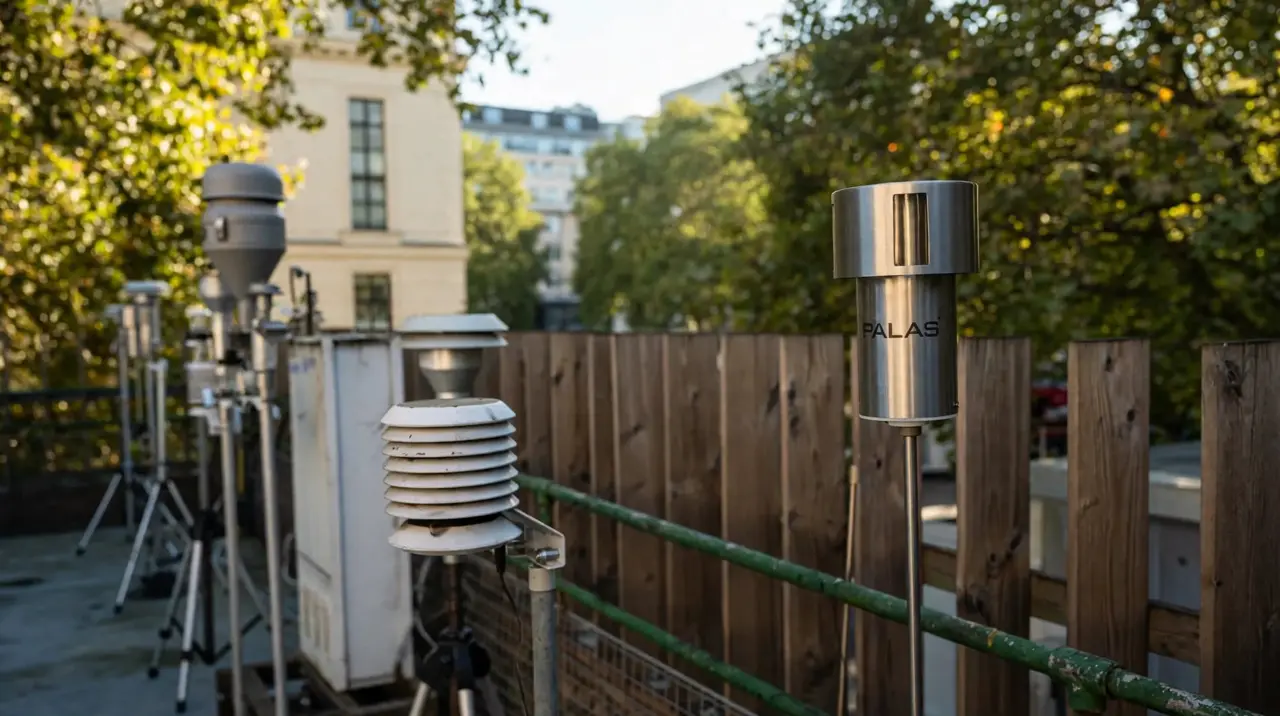
Inside a wooden cabin on Marylebone Road, instruments record air pollutants, and the readings are then examined by teams at ICL.
Among them is a particulate monitor, which measures how much particulate matter is present in the air.
"From a health view point, that is the most important piece of equipment," says Prof Frank Kelly, who heads the team at Imperial.
"It measures tiny particles, less than 2.5 microns in diameter. A human hair is 60 microns - so you have no chance of seeing them."
Over the weekend, the monitors informed the team that particle concentrations were "very high".
"At the weekend, we had that really cold weather, the inversion with all the fog, the pollution couldn't escape," he explains.
Chimneys mounted on the cabin roof draw in air particles and channel them down to the monitors inside.
Kelly said the monitors indicated that traffic was not responsible for the pollutants, with some also arriving from the Continent, from shipping in the English Channel and "obviously from bonfires and fireworks".
The alert, which concluded on Tuesday evening, also advised Londoners to avoid driving and to limit their use of wood burners wherever possible.
Jemima Hartshorn, who founded the air pollution campaign group Mums for Lungs, described the alerts as a wake-up call regarding the poor state of London's air quality.
"We could all smell it, we could feel it, we could taste it - London is very, very polluted," she says.
"We need to be really frank and think about and talk about the government's responsibility here.
"We need to see much bigger change than each of us as an individual can do to truly clean up our air."
Despite London's pollution levels remaining high, BBC analysis indicates that the capital's air quality has improved considerably over the last ten years.
Average nitrogen dioxide (NO₂) concentrations have dropped by nearly 38% since 2014, and every neighbourhood now complies with the UK legal limit of 40 micrograms per cubic metre (μ g/m³) as an annual average.
However, fewer than 1% of neighbourhoods satisfy the World Health Organization's recommended guideline, set at 10 μ g/m³ - a quarter of the UK legal limit.
Kelly remains optimistic about the direction of travel for the city's air quality.
"London is really leading the world in basically getting its air quality under control and that's mostly because of what's happened since 2019 when the ultra low emission zone was introduced in the city," he says.
"Initially it was just in the central area but now it goes right out to the M25, so the biggest controlled emission zone in any city in the world."
Listen to the best of BBC Radio London on Sounds and follow BBC London on Facebook, X and Instagram. Send your story ideas to [email protected]
Source: