Sheep, a fatberg and a giraffe: London Museum opens at Smithfield after a £437m revamp
Ten years after the Museum of London first announced it would quit its previous home for the empty halls of Smithfield Market, the institution - rebranded the London Museum - is preparing to welcome the public on Saturday, the culmination of a £437m scheme.
Tim Stokes Updated 25 nov
Ten years after the Museum of London first announced it would quit its previous home for the empty halls of Smithfield Market, the institution - rebranded the London Museum - is preparing to welcome the public on Saturday, the culmination of a £437m scheme.
Sharon Ament, the museum's director, settles back into a leather sofa in a huge brick-lined hall that once rang with the noise of market traders and is now filling with its first visitors.
"I really love this space, it just makes me smile every time I come in - it's actually joyful," she says.
The room, named Our Time, holds installations that draw on living memory: a life-size mechanical giraffe twitching its ears in front of a lit-up NHS sign recalling lockdown, fragments of the capital's former greyhound tracks, and the old switchboard from Buckingham Palace. Beneath the domed ceiling wander flocks of oversized plastic sheep, which Ament invites visitors to "pull up and take a seat" on.
"There are grins on people's faces, so I think we've pulled something rather incredible off," she adds.
The visit actually begins earlier, along a covered street called Real Time, where digital screens stream live data about London beside a sentry box covered in Banksy graffiti and the last bell cast at the historic Whitechapel Bell Foundry. Visitors then pass into the former General Market, home to the sheep, giraffe and signage.
That hall will host late-night house parties and dinner clubs as well as shops and restaurants, among them restored Victorian cocoa rooms that will stay open around the clock at weekends. Traces of the building's former life survive throughout: halfway up the walls sit the restored fireplaces of the traders' old offices, reached by twisting metal staircases.
"Whenever we've found historic fabric, we've restored it or kept it, and we want to show the layers of history," explains Alec Shaw, who has overseen the whole project.
"We wanted a museum that worked like the market, that allowed you to come in any corner and just walk across, walk through the building on your way to work, or, hopefully, stay a bit longer."
Shaw led me around the site almost three years ago, when scaffolding propped up the walls and water dripped constantly on to the floor. Reviving a Victorian structure abandoned in the 1990s "really tested all of us", he concedes - and that was before the challenge of designing a museum from the venue's seven-million-object collection. Five thousand objects are already in place, with another 300,000 due by the time the former Poultry Market opens as a museum space in 2028.
"We think you could take at least eight hours to see every object downstairs, and that means you're going to keep coming back," he says. "The best museums are those that you go, 'Right I'll do that one today. I'll do this gallery next time.'"
A broad staircase on one side descends into Past Time, built on what was the street level of Roman London. Curator Annette Day says "we felt that right in the guts, in the earth of the city, that was the place where we should explore London".
A winding path beneath a seven-metre-high brick vaulted ceiling carries the capital's story from its Roman founding through the medieval period and London's role at the centre of the British Empire, closing with the 2012 Olympic Games, when "London looked at itself and the world looked at London", Day says.
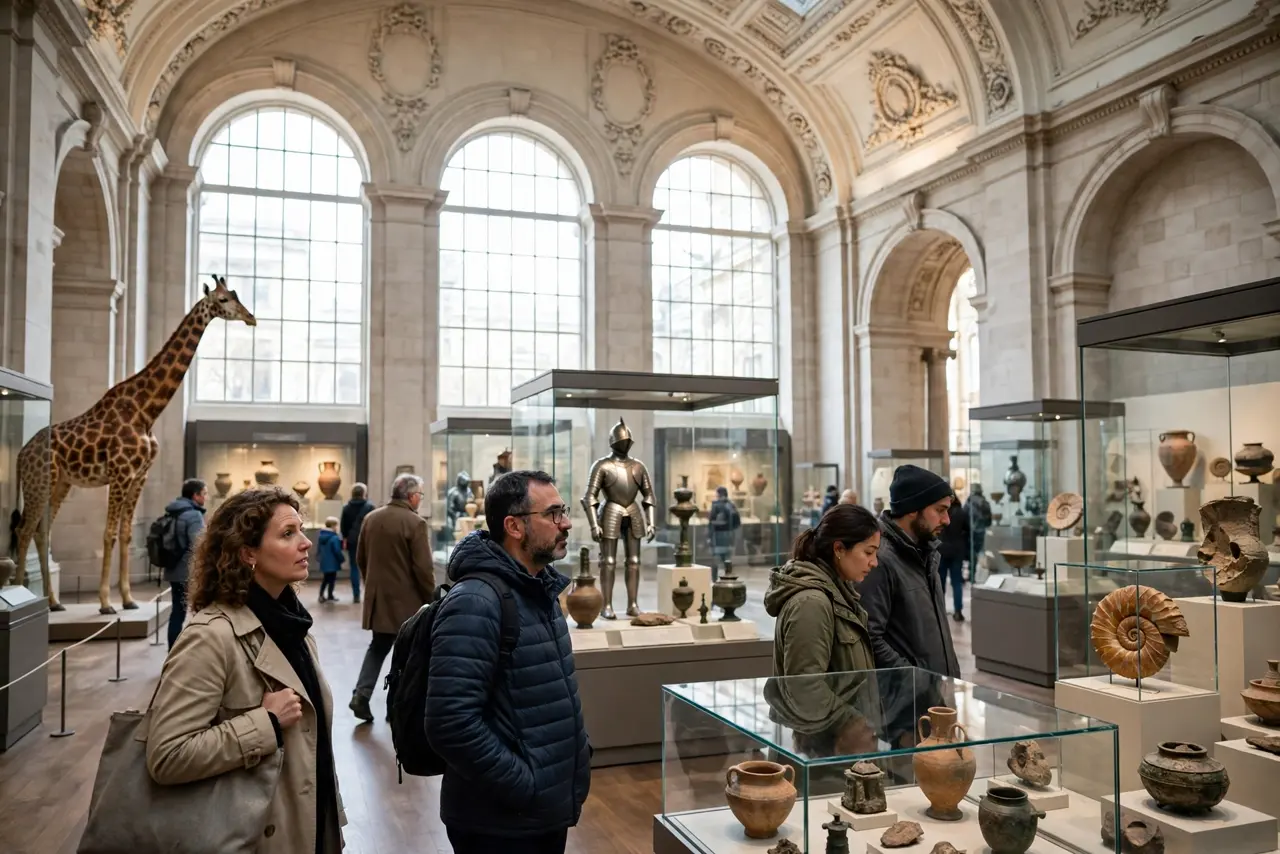
Objects along the way include Charles I's execution vest, Queen Victoria's mourning dress, a white 1960s Ford Cortina, an overstuffed taxidermy cat named Oliver and the shimmering Elizabethan jewellery of the Cheapside Hoard.
Side galleries dwell on particular moments. One recreates a Roman room with amphoras, a mosaic floor and pieces of a magnificent wall painting found in Lime Street 20 years ago; another uses large comic illustrations based on new research to recount the Great Fire of London, partly to reflect the subject's place in Key Stage 1 of the national curriculum.
Two further archways branch off to examine the lives of Londoners and the city's landscape, placing objects from across the ages side by side. In one case the delicately feathered Dying Swan outfit of the Russian dancer Anna Pavlova stands beside the stage costume of Edwardian music hall star Kitty Lord; another displays 2,000 years of shoes made in London. One case is filled entirely with toilets and chamber pots from medieval times to today.
On the far wall, a small porthole frames a chunk of the eponymous Whitechapel fatberg, not far from the huge glass window through which Thameslink trains pass - their passengers, apparently, have yet to notice they are now being watched.
Even with its planned events, shops and eateries, Ament insists the objects remain "the essence of the museum", because they "tell stories in a compelling way". She sees the building as a shared space for Londoners and tourists alike to connect with people and stories from the past and the present.
"Think of this as like one of my favourite buses, the number 63 bus. You meet the world on it. And you meet the world in here."
Above all, she says, the London Museum must always represent and reflect the city it sits in.
"The story of London is tough and joyful at the same time. That's why we use 'grit and glitter' as a tagline - it's both of those things, those dualities can exist. And we shouldn't be frightened of that history," she says.
"We are making a museum and it will never stop, just like London never stops. There's always cranes in London and there'll always be new things in London Museum."
Source: