Blackouts delay exhibition of Cuban film posters in London
A collection of 11 silkscreen prints, produced by the poster workshop of ICAIC, Cuba's national film institute, is now showing in London. The workshop made them for the recent London Latino Film Festival, which took place in October.
Adriana Elgueta Updated 25 nov
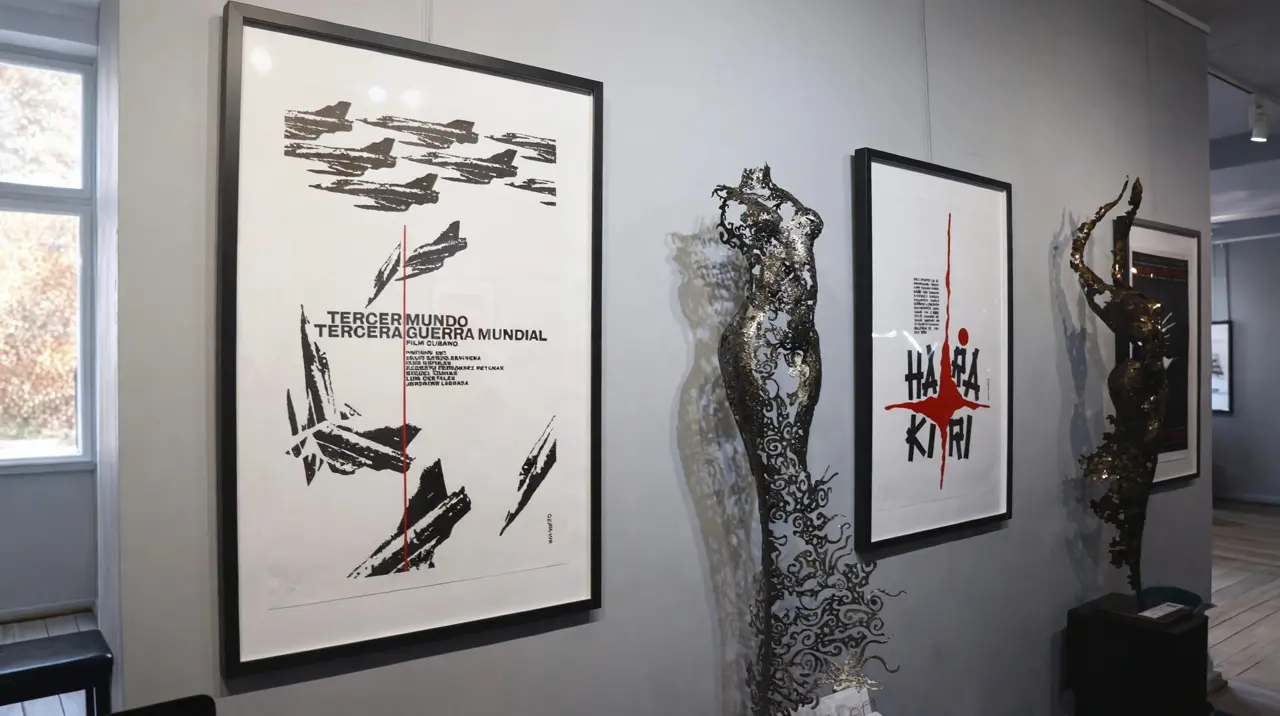
A collection of 11 silkscreen prints, produced by the poster workshop of ICAIC, Cuba's national film institute, is now showing in London. The workshop made them for the recent London Latino Film Festival, which took place in October.
The group had originally planned 25 designs, but power cuts, water shortages and missing materials stretched the work over several months, and only 11 prints were completed.
"We can't do anything without power," said master printer Markito Guerra Rojas. "Number one, we can't see. Number two, the materials start to go wrong."
According to the workshop in Havana, the prints use black, white and red because no other inks could be obtained. They were dispatched to London inside a cement bag to shield them during transit.
Guerra Rojas and his four-person team have worked at the same Havana workshop for 20 years, and spent much of the year following the power grid's schedule.
"A neighbour would let us know the power had come back, we'd start printing, and the power would go again," he said.
"Sometimes we had to stay, because how were we going to leave in that darkness?"
Cuba has dealt with acute fuel shortages since January, when the US halted oil shipments from Venezuela and threatened tariffs against any country supplying the island. As most of the country's electricity is generated from oil, the workshop reported that certain neighbourhoods in the summer went nearly a week without power.
The UN has stated that the restrictions are hurting ordinary Cubans, while the US State Department has attributed the blackouts to mismanagement by the Cuban government.
For the printers, sourcing supplies became another difficulty. "There used to be companies that imported them. Now nobody does," Guerra Rojas said.
"There's no paper."
Silkscreen printing, also known as serigraphy, is carried out by hand: ink is pushed through a fine mesh on a frame, one colour at a time. Every colour requires a separate screen, its own hand-mixed ink and its own drying period.
The photographic emulsion that attaches each design to its screen is ruined when the electricity fails, and without power the press loses the suction that keeps the paper flat.
"Something we might have done in a month, because while one colour was drying we could have been printing the next, we couldn't do," he said. "We'd do one colour and finish it, and then there was no power to prepare the screen for the next colour. It was catastrophic."
Six decades of design
ICAIC was established in 1959, several months after the Cuban revolution. Its publicity department, under Saúl Yelín, ruled that film posters should be treated as design works rather than advertising. What started as a practical necessity grew into a national art form, holding a place in Cuban cinema alongside the films themselves.
With no box office figures to target, designers produced posters for everything from Soviet dramas to Hollywood westerns, each centred on one bold concept rendered in a few flat colours.
Silkscreen was also well suited to a country lacking industrial presses, and it remains the technique used for the posters. Guerra Rojas thinks his may be the only workshop anywhere still screen-printing posters to publicise films.
A number of these posters are now acknowledged internationally as significant cultural heritage. The 1960–1980 collection was entered on UNESCO's Memory of the World Register in 2023. This is also the first occasion the posters have been created for an event outside Cuba.
He does not regard the smaller edition as a failure.
"You depend on one thing, then another, then another to get there," he said. "That's also where the value of serigraphy lies: in the way it's made."
Irinka Cordovi, who runs the workshop, said she hoped visitors to the exhibition "feel the same admiration we feel for these works of art, because they really are true works of art, and that they value them, admire them and enjoy them".
The posters remain on show at Eclectic Gallery until 9 December.
Listen to the best of BBC Radio London on Sounds and follow BBC London on Facebook, X and Instagram. Send your story ideas to [email protected]
Source: