London's only round-the-clock hospital helipad celebrates 10 years of saving lives
They are the group you would rather never encounter.
Wendy Hurrell (London) Updated 25 nov
They are the group you would rather never encounter.
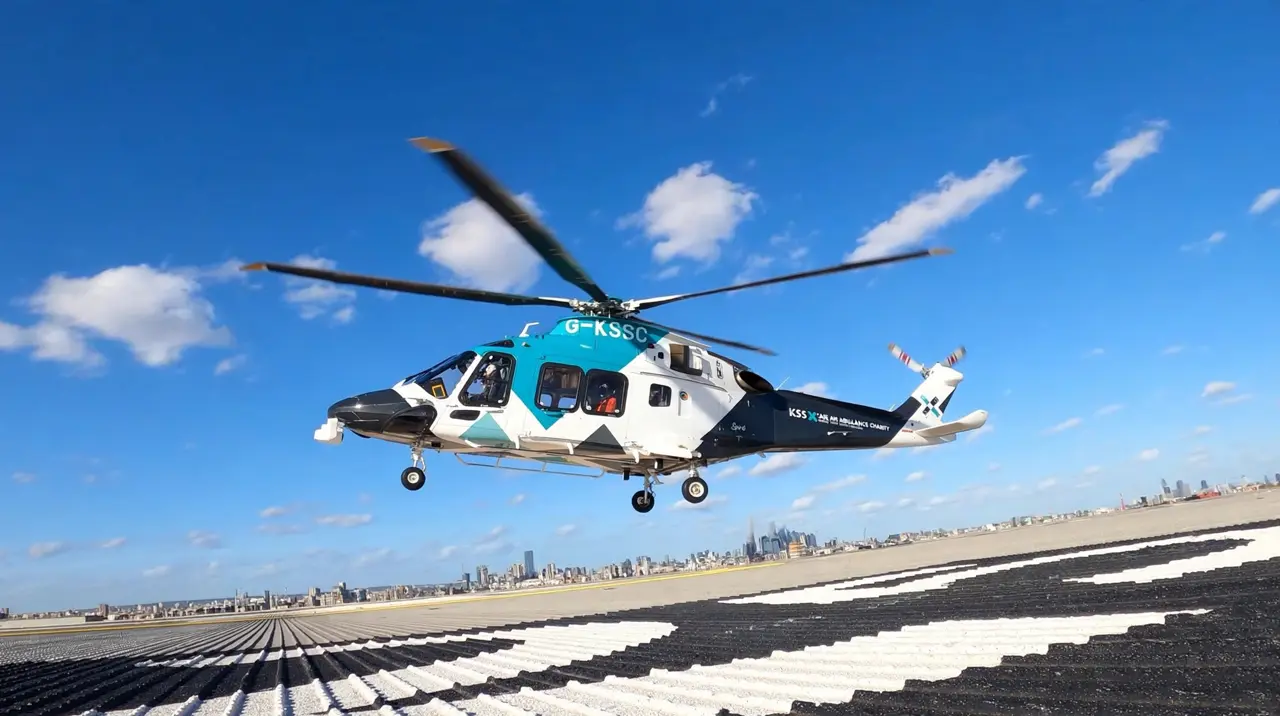
The team gathers on the roof of King's College Hospital, located in Denmark Hill, to take in patients in the most critical condition. Their ranks include a trauma nurse, a helideck security officer and a porter with dedicated training.
The patients brought in by helicopter have been involved in road traffic collisions, falls, strokes and heart attacks.
Since the landing pad at this south London hospital began operating 10 years ago, air transfers have offered patients a better prospect of survival, since in medical emergencies each minute is crucial.
Carole Olding, the hospital's lead nurse for major trauma, said: "Having this deck has actually revolutionised how we treat people because we're treating them much quicker."
The facility ranks among the busiest hospital helidecks in London and is the only one that functions around the clock.
Prior to its opening in October 2016, helicopters ferrying patients to the hospital had to touch down in the neighbouring Ruskin Park.
The trip onwards to the emergency department could take close to half an hour. Today, the transfer from landing to resuscitation is said to take under five minutes.
Malcolm Tunnicliff, clinical director for major trauma, explained: "Time really matters if you've got a brain injury.
"The quicker we can do the operation, the better chance the brain has of recovery so knocking [minutes] off really does make a difference."
A day on the helideck
For the 10-year milestone, the helideck team welcomed BBC London to observe how the arrangement operates and to show the speed with which patients are moved and treated.
The process begins with a call from the helicopter pilot at the scene.
A red phone rings at the centre of the emergency department, and the trauma nurse on duty picks it up.
The helipad is activated and the medical team gathers.
On the ninth floor, the control room alerts the helideck officer. During the filming, David Kassim was handling security and the necessary checks.
He said: "I'll speak to the pilot and he'll advise me on the ETA. I do all the safety checks and make sure there are no hazards that would prevent them from coming in and landing safely.
"I'm checking for the lighting, making sure it is operational. I'm checking to make sure that everything is legal and safe."
At the same time, one of the hospital lifts is put into emergency mode so that the motorised stretcher can be lowered without delay.
A specially trained porter readies the bed.
Olufemi Akinona, a porter at the hospital, explained that the three groups work closely together as a team.
"Only me cannot do it. And only security cannot do it. Only trauma nurse cannot do it. So the three sections will work together," he said.
He added that he waits at the foot of the ramp until the helicopter has landed and shut down its engines.
"[The pilot] gives me the thumbs up, so I take my trolley up with my trauma team. It's not taking us two minutes - two minutes, we are already in resus."
King's is one of four major trauma centres in the capital and also covers Kent as well as south-east London.
According to hospital figures, more than 2,300 landings have been recorded over the decade.
The Air Ambulance Charity Kent Surrey Sussex transports the majority of patients.
Regular landings are also made by the London Air Ambulance, Essex & Herts Air Ambulance and the Children's Air Ambulance.
Olding said: "We're treating the sickest people and you can only do so much. But at least they have a chance.
"They have a greater chance than they did prior to 2010 when major trauma centres came in."
The helipad, however, could not have been built without £2.75m provided by the County Air Ambulance HELP Appeal and £500,000 gathered from patients, staff and the local community via the King's College Hospital Charity.
Tunnicliff said: "I think the most important donors were the local people."
He mentioned that he had kept a note attached to a small donation from a couple which read: "I'm sure that this will only pay for one bolt but we hope it makes a difference."
Olding added: "There were some amazing people [in and out] of King's College Hospital that were doing some of the most interesting, dangerous and most crazy things to raise money.
"You know, I would never sit in a bath of baked beans for anyone. Or abseil down the side of the Golden Jubilee Wing.
"But there were lots of people who were doing that and raising phenomenal amounts of money."
The money raised has enabled the NHS trauma team at King's to bring critically ill patients into hospital care more swiftly over the past ten years.
Akinona added: "It's so simple - just to care for life, save lives. Because it could happen to anyone."
Listen to the best of BBC Radio London on Sounds and follow BBC London on Facebook, X and Instagram. Send your story ideas to [email protected]
Source: