Was the Rogers handball penalty the right call, despite the lack of common sense?
It is unusual for a decisive handball call to draw widespread agreement that the ruling was right.
Dale Johnson (Football issues correspondent) Updated 25 nov
It is unusual for a decisive handball call to draw widespread agreement that the ruling was right.
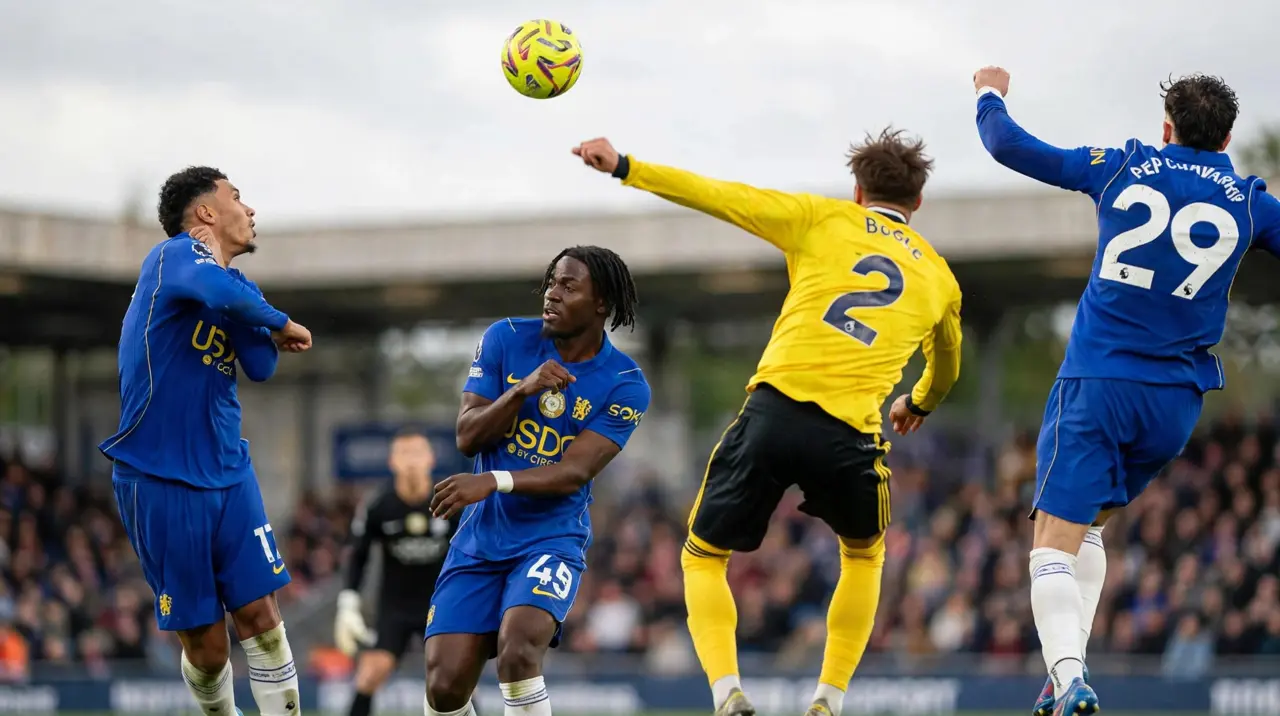
The debate usually turns on whether a more lenient reading should be adopted based on the apparent intention of the player involved. That argument resurfaced following the decisive penalty awarded against Chelsea in Saturday's 4-1 home defeat by Leeds, which ultimately put the visitors ahead for the first time.
Despite that perception, handball penalties are actually less frequent in the Premier League than in the other top five European leagues. Last season, the English top flight's 380 matches produced 22 handball penalties, easily the lowest total. Spain's La Liga (36) and Italy's Serie A (38) recorded the highest numbers. This season, the Premier League has seen three in 106 matches, fewer than in 2025-26.
So why was Morgan Rogers penalised?
Why the penalty was given
The prevailing view among Premier League clubs is that handball is currently handled well: the arm must be fully extended away from the body, raised, or the offence must be a deliberate act in order to be punishable. It was the third of these criteria that applied to Rogers, which some may regard as harsh given the Premier League's more relaxed reading of the handball law.
There are, however, several key reasons why referee Michael Oliver pointed to the spot, why the video assistant referee (VAR) did not intervene, and why the decision will be judged as correct.
Two of the factors a referee considers when assessing a possible handball apply in this case.
First, the distance the ball travelled. Because Jayden Bogle's effort came from range, a defender is deemed to have more time to adjust their body and react, and therefore to avoid a potential handball.
Most importantly here is the movement of the arm. When Bogle struck the ball, Rogers' arm was not raised, but it moved up into the ball's path. Crucially, had Rogers left his arm where it was, lower and level with his midriff, there would have been no handball offence. Put simply, if the ball would have struck the body had it not come off the arm, it is considered to have had no impact. This case was different: Rogers lifted his arm and that is what deflected the ball away. This is treated as a deliberate act, and that overrides all other considerations.
Was there any case not to give it?
Perhaps the question is whether the ball struck Rogers too high on his arm, and therefore should not have counted as a handball offence. It was close, but it appeared to be in what the laws call the 'red zone', the part of the arm which is punishable for handball.
That would really have been the only reason for VAR, Michael Salisbury, to consider an on-field review.
A comparable case arose last season in terms of how this type of handball offence is judged, coincidentally involving a penalty awarded to Leeds. As Anton Stach's powerful strike headed towards goal, Everton defender James Tarkowski leaned to his left in an attempt to block the shot, and did so with his arm tucked tightly against the side of his body. Everton manager David Moyes described the decision as "wrong", but it was absolutely correct in law. The proximity of Tarkowski's arm to his side was irrelevant because of the deliberate act of leaning into the path of the ball. Similarly, Rogers raised his arm to stop the ball, making the penalty a justifiable call.
Decision underlines dissatisfaction with handball law
Even though the Premier League already applies a more lenient interpretation of the handball law, it is clear that many observers want it to go further. BBC Match of the Day pundit Alan Shearer echoed many when he argued that more intent should be required for a handball.
"I didn't agree with the penalty when Michael Oliver gave it," he said.
"I know once the on-field decision is made there is a high bar to review it, but I don't think officials are allowed to use common sense.
"Morgan Rogers is not deliberately trying to stop the ball. He just doesn't want it hitting him in the face.
"Although the penalty came at an important point in the match, Chelsea were deservedly beaten by a much stronger, far more physical and better-organised Leeds team."
Rogers may maintain that he raised his arm to protect his face. This is one of the possible mitigating factors, but it usually applies only when a player lifts their hands to their face rather than using the arm as a barrier.
Chelsea boss Xabi Alonso said that, while he did not "want to make a big thing about it", the penalty should not have been awarded.
"For me it was quite a harsh decision," he told Sky Sports. "I would not have given a penalty. I don't want to make a big thing about it but for me it's not a penalty."
Source: