TfL report: floating bus stops present 'low risk' to pedestrians
One of three documents published on Friday by Transport for London (TfL) acknowledged that such stops may discourage older and disabled passengers from using public transport, though it described this share as "not statistically significant".
Kumail Jaffer (Local Democracy Reporting Service), Ruth Comerford (London) Updated 25 nov
One of three documents published on Friday by Transport for London (TfL) acknowledged that such stops may discourage older and disabled passengers from using public transport, though it described this share as "not statistically significant".
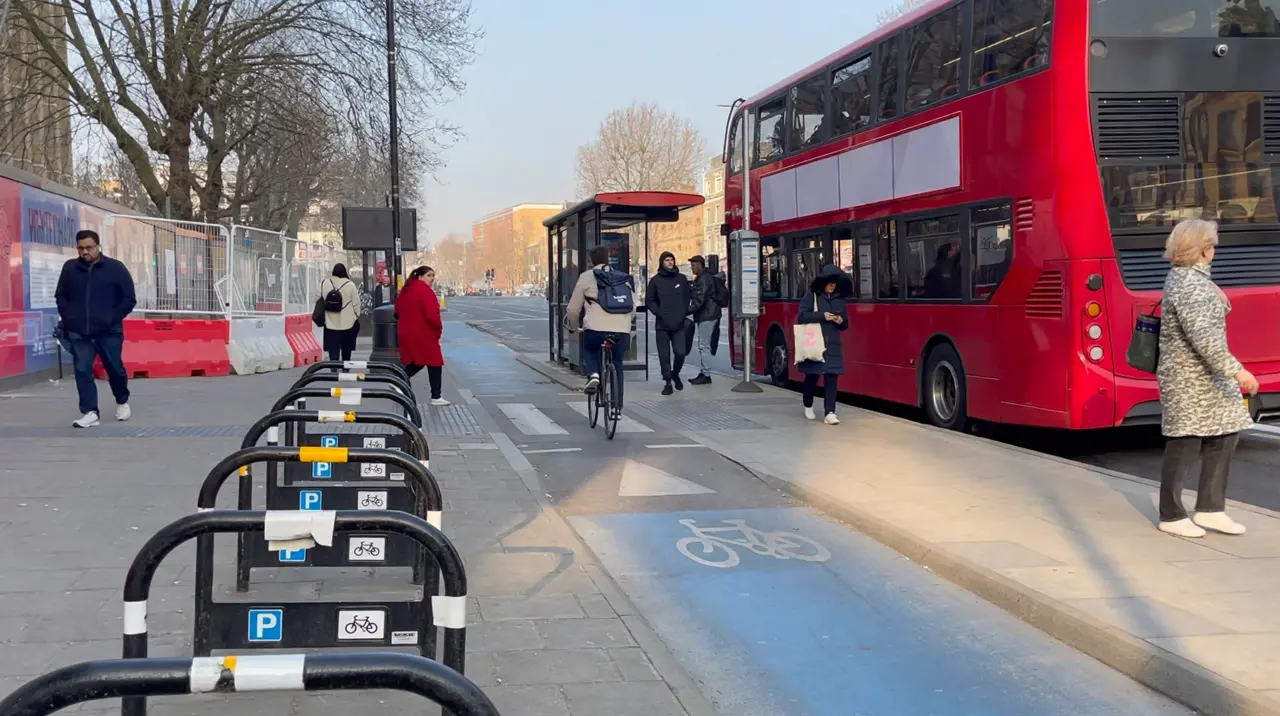
The term floating bus stop, also referred to as a bus stop bypass (BSB), describes a road arrangement in which a separate cycle lane passes behind the passenger waiting area, dividing it from the main pavement.
Sarah Gayton, from the National Federation of the Blind (NFB), described BSBs as "absolutely abhorrent" and "not fit for purpose for all people".
Over 290 bodies representing blind, deaf, disabled, partially sighted and elderly people had earlier written to the prime minister to raise accessibility and safety worries about floating bus stops and to request their removal from road infrastructure.
In the previous year, the government announced a halt to the rollout of the Shared Use Bus Border (SUBB), a design where the cycle lane crosses the front of the bus stop, while leaving future BSB construction unaffected.
TfL's newly published reports state that it is "rare" for a pedestrian and a cyclist to "interact" at a floating bus stop. According to the analysis, only five pedestrian casualties involving cyclists and one involving an e-scooter were recorded over a three-year period, against 11,400 pedestrians injured by motorists during the same span.
Gayton, however, said the actual number of injuries is much greater because numerous incidents at floating bus stops are never reported.
"What we have is people not telling the police or reporting if they've been hurt, because they don't know who's at fault," she said.
Gayton has personally recorded several collisions, five of them at a single floating bus stop close to St Thomas' Hospital in 2024.
The recent reports exclude that period and instead draw on data covering March to August 2018 and March to August 2023, comparing conditions before and after BSBs were introduced.
Erik Matthies, who has sight loss and serves as the Royal National Institute of Blind People's (RNIB) policy lead for travel and transport, said the organisation's research indicated that 40% of blind and partially sighted people steer clear of floating bus stops altogether.
"Low injury reports don't tell the whole story - there is no safe and accessible way for people like me to cross the cycle lane to and from a bus stop, and today's review from TfL does not address that," he said.
Earlier in the month, the London Assembly requested a pause in installing floating bus stops, stating that the designs had left some people "fearing for their safety".
London TravelWatch, the capital's transport watchdog, likewise called for an end to the building of any additional BSBs.
TfL stated that it has suspended bus stop designs obliging passengers to step straight into a cycle lane, while work continues on three floating bus stops where cyclists travel behind the waiting area.
Christina Calderato, TfL's director of transport strategy, said every individual should be "able to travel safely, confidently and independently around London".
"These reports provide important evidence about bus stop bypasses, the concerns that some people have raised, and the action we are taking with partners to improve safety and accessibility for all users."
Will Norman, London's walking and cycling commissioner, said the mayor's office was "committed to enabling safe and sustainable travel across the capital for everyone".
"It's encouraging to see data confirming that the risk of bus stop bypasses to pedestrians is extremely low, but also that TfL remains committed to making this infrastructure work for everyone."
Listen to the best of BBC Radio London on Sounds and follow BBC London on Facebook, X and Instagram. Send your story ideas to [email protected]
Source: