Rail bridge in Leicestershire again tops Britain's most struck list
Network Rail announced on Sunday that the A5 Watling Street bridge in Hinckley had led its 2025-26 ranking, registering 26 strikes between 1 April 2025 and 31 March. Seven further incidents have been reported up to September.
Sonia Kataria (Leicester) Updated 25 nov
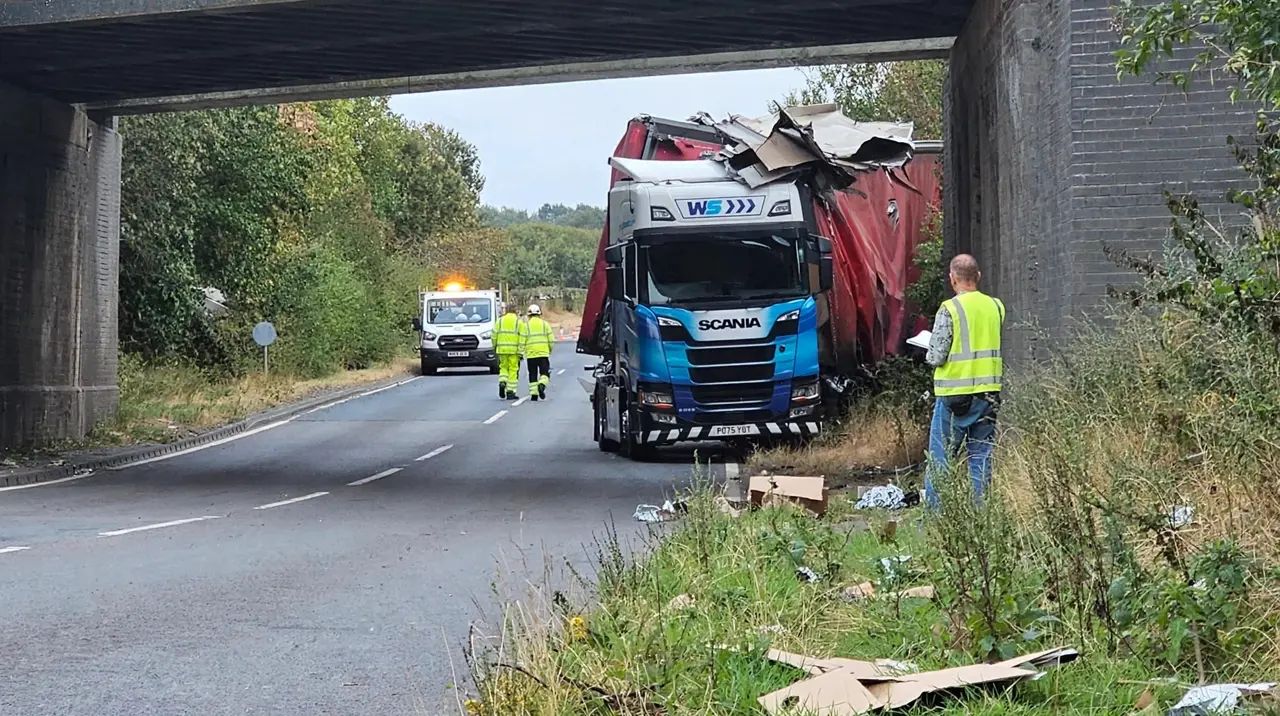
Network Rail announced on Sunday that the A5 Watling Street bridge in Hinckley had led its 2025-26 ranking, registering 26 strikes between 1 April 2025 and 31 March. Seven further incidents have been reported up to September.
Campaigners have called for action to stop the disruption these crashes generate, among them lowering the road that passes beneath the bridge, although Network Rail has not yet approved that scheme.
According to the rail infrastructure company, 1,706 bridge strikes were logged in 2025-26. They produced 185,319 minutes of delays and roughly £13.25m in costs arising from delays, cancellations and repairs.
Network Rail also stated that it is collaborating with transport organisations and local authorities to raise awareness, while deploying technology intended to reduce incidents and speed up its response to strikes anywhere in Britain.
The Watling Street bridge was named Britain's most bashed bridge for the second consecutive year, after being struck 22 times during the 2024-2025 financial year.
The most struck railway bridges in 2025-26
Watling Street A5, in Hinckley, Leicestershire - 26 strikes
Stuntney Road, in Ely, Cambridgeshire - 24 strikes
Stonea Road, in Stonea, Cambridgeshire - 23 strikes
Station B4105, in Berkswell, West Midlands - 18 strikes
Hayfield Road A624, in New Smithy, Derbyshire - 14 strikes
Coddenham Road, in Needham Market, Suffolk - 14 strikes
Abbey Farm, in Thetford, Norfolk - 13 strikes
Warminster Road, in Westbury, Wiltshire - 13 strikes
Mantle Road, in Brockley, South East London - 13 strikes
Barrowby Road, in Grantham, Lincolnshire, Prescott Street, in Wigan, Middleton Road, in Surrey, and Poole Road, in Poole - all struck 12 times
The latest national totals from Network Rail - 1,706 strikes between April 2025 and March - compare with 1,666 in the 2024-25 financial year, 1,532 in 2023-24, 1,588 in 2022-23 and 1,864 in 2021-22.
In Leicestershire, the plan to lower the road beneath the bridge received planning permission in 2023. Network Rail says it is still being reviewed.
Campaigners expressed doubts that the proposal would ever be approved, and said they hoped other measures would be introduced to avert further crashes.
In August, lorries struck the crossing on two consecutive days.
A Network Rail spokesperson said: "We continue to work on proposals to lower the road beneath the bridge.
"As with any project affecting the operational railway, detailed designs and associated works information must be submitted and reviewed before the scheme can progress.
"We remain committed to supporting the development of this proposal."
To coincide with Road Safety Week, Network Rail listed the 10 most bashed railway bridges and called on drivers to "wise up" and "size up" by verifying vehicle heights and planning appropriate routes before each trip.
In December, the company started a three-month trial of technology "designed to support faster assessment of bridge strikes".
Cameras and sensors were installed at the Harlaxton Road bridge in Grantham, Lincolnshire, to supply "real-time alerts and capture data and video footage following a collision".
"Network Rail is using the findings to refine the technology, maximise its benefits and assess its potential for future use," a spokesperson said.
Preventive measures such as warning signs and protective beams are also being developed, including at the Bishton Road bridge in Newport, Wales, where goalposts have been installed on both approaches to stop over-height vehicles reaching the structure.
Network Rail staff have also visited haulage businesses to "raise awareness of the risks and encourage operators and drivers to check vehicle heights and plan suitable routes before setting off".
Martin Frobisher, group safety and engineering director, said: "A bridge strike is never a minor incident. It can put drivers, passengers and railway staff at risk, damage vital infrastructure and cause significant disruption while our engineers make sure the railway is safe.
"We are asking drivers and operators to take simple steps before every journey: know the height of the vehicle, check the route and pay close attention to bridge restrictions. We're also working closely with industry partners, local authorities and haulage businesses, using technology and physical prevention measures to help stop strikes happening and respond more quickly when they do."
Listen to BBC Radio Leicester on Sounds and follow BBC Leicester on Facebook, on X, or on Instagram. Send your story ideas to [email protected] or via WhatsApp on 0808 100 2210.
Source: