Politics and pedestrians: The plan to clear traffic from Oxford Street
On a sunny summer day in 2024, the mayor of London's senior advisers gathered at City Hall to discuss one of the most disputed problems facing the city: how to keep vehicles out of Oxford Street.
Tom Edwards (London transport and environment correspondent) Updated 25 nov
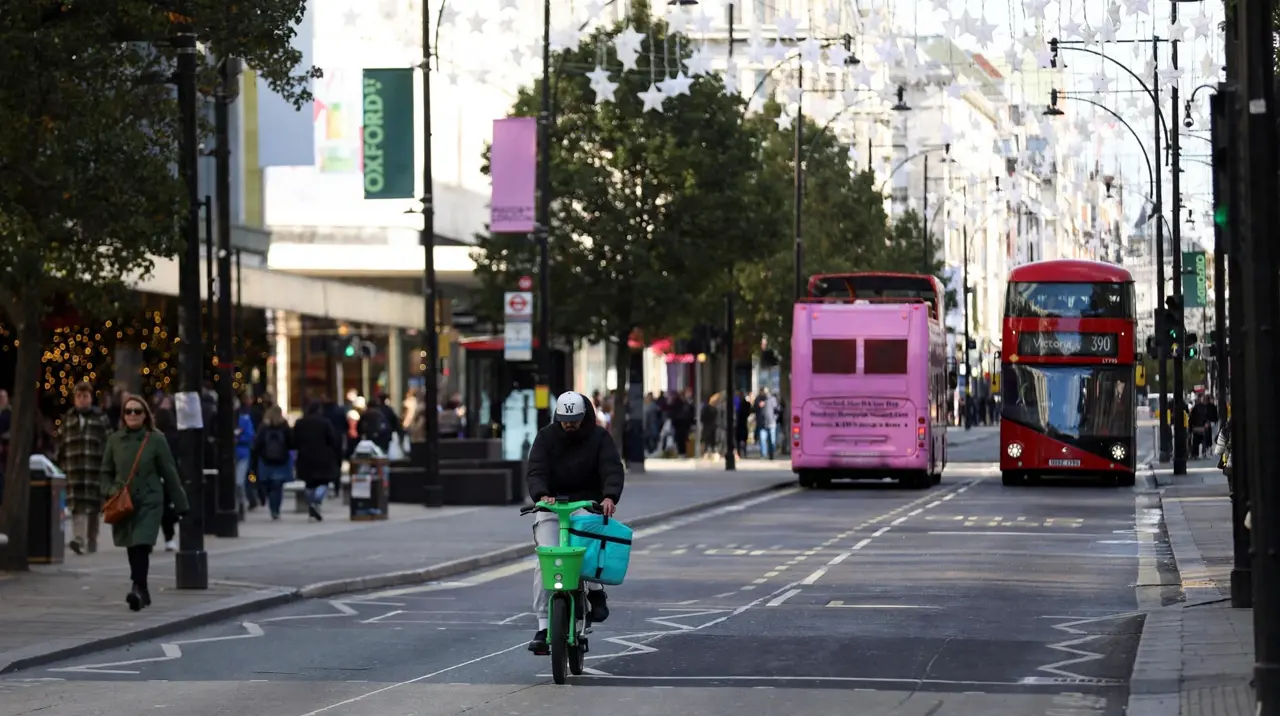
On a sunny summer day in 2024, the mayor of London's senior advisers gathered at City Hall to discuss one of the most disputed problems facing the city: how to keep vehicles out of Oxford Street.
At that planning meeting, they were promoting a different way forward.
The question of turning London's best-known shopping street into a pedestrian zone had troubled successive mayoral administrations for years.
Each new proposal was blocked by Westminster Council, which owns the street and is sensitive to the marginal seats on either side of the argument.
This time, the mayor's advisers offered him another route out of the deadlock: the creation of a development corporation.
The idea of using a development corporation for Oxford Street had already been raised at City Hall as early as 2018, when another scheme was abandoned.
Sadiq Khan had included the pedestrianisation of Oxford Street in his 2016 manifesto, and work on plans for it progressed.
However, in 2018, the then-Conservative Westminster Council rejected the proposal after local residents opposed it.
That opposition came after residents put forward candidates to stand for election on a single-issue anti-pedestrianisation ticket. Faced with this challenge, the council reversed its position.
The traffic-free proposal had already been through a consultation and had the council's backing. London Mayor Lord Khan described the reversal as "a betrayal".
A development corporation provided a way around the impasse.
It would involve a mayoral body taking charge of how Oxford Street is developed, while Westminster Council loses its planning powers for the area.
Three Westminster councillors would be members of the 12-person board, along with one from Camden. The mayor would appoint the remaining members.
Setting up a development corporation in a central London location with a mixed residential character would be unprecedented, since the method had previously been used only to convert brownfield industrial sites at the Olympic Park and Old Oak Common.
Critics argued that this was anti-democratic and would disenfranchise local people, but the mayor said residents could not be allowed to obstruct the development of the UK's main high street.
The Conservative leader of Westminster City Council accused Lord Khan of "cheating the system".
Nevertheless, the Oxford Street Development Corporation (OSDC) was established.
Many local residents have felt excluded from the democratic process ever since. They fear traffic will be displaced onto their roads, with buses, taxis and bikes rerouted through neighbouring streets.
Karen Jones, who has lived in the area for 20 years, is concerned about what will happen to their "beautiful garden neighbourhoods".
"You just cannot take 30 or 40 bus routes, and then switch them into green neighbourhoods with playgrounds and children, and expect they'll stay the same."
Michael Bolt, from the Marylebone Association, believes the area's "fairly village atmosphere" will be damaged because "the traffic's just going to have to find ways around Oxford Street".
"Wigmore Street is going to be pretty well crushed with traffic, and traffic will then have to move up through Marylebone to try and get through."
He points out that when "this same plan came up in 2018, we were able to get rid of that as we had 54 democratically elected councillors, and it was for them to decide.
"Now we have a commission of 12 controlled mainly by him [Lord Khan] and he's able to push this through without us being able to have a say in it. Now it's impossible to exercise a democratic right."
Crucially, establishing the OSDC and removing the council's powers required sign-off from the secretary of state for housing, communities and local government.
At the time, that was Angela Rayner. Before 2024, approval from a Conservative government was unlikely.
City Hall insiders say Rayner's support was "great" and essential to the creation of the OSDC.
They also say pedestrianisation involves more than the highway itself.
The mayor's vision required a body to supervise the transformation and to build a cultural and retail destination, they argue.
The creation of the OSDC was vital to that aim.
Nick Bowes, a former mayoral director at City Hall and now a partner at the communications agency LCA, says the 2024 general election was key to the move, as "everything changed, suddenly the political stars aligned".
He acknowledges that the use of a development corporation "isn't without controversy", since City Hall and the local authority, along with the people they represent, see the West End in different terms.
"City Hall and the government take a view that the economic contribution of the wider Oxford Street area is of strategic importance, not just to London but to the country as a whole.
"In their view, decisions about the future of the area can't just be taken at a local level based solely on local considerations.
"In this respect, OSDC is no different to other development corporations, and the reaction by some to the creation of a 'devco' as 'anti-democratic' is what was also seen in Stratford and west London."
Robin Smith runs a stall on Berwick Street. He believes this is only the beginning of a process that will destroy the character of the West End.
"I think that closing Oxford Street will just move all the buses, the cabs, the motorcycles, the delivering vehicles, and the bicycles on to the backstreets, which are residential.
"So all of that congestion is going to go into smaller streets, which are less able to cope with it. And that's gonna create misery for anybody living north of Oxford Street, because their whole livelihood's going to be turned upside down by this."
He also fears small traders will be pushed out by larger corporate enterprises, along with the potential impact of more people coming to the area.
"I think it's tragic - 20,000 people coming [to the West End] in the evening is one thing, that's what Soho is and has always been.
"But if it's more like 200,000? That's the size of two Wembleys with no security and no sanitation. There's no public toilets, there's no facilities for this, so the whole thing crumbles."
The main work of transforming Oxford Street will not really begin until the spring, as no construction is possible during the busy Christmas period.
Councillor Tim Barnes, deputy leader at Westminster Council, is worried that the plans are not fully-formed.
"We are concerned that some of the things that you'd expect at this point to have been resolved haven't yet been resolved. It's been the case right the way through this process that it's felt rushed, and it's felt under-resourced."
"Realistically, if we wanted this to be the best that it could be, we would have taken more time over it, and the mayor wouldn't have put this artificial deadline on things," he adds.
"We'd have had a much better scheme if we'd launched it next year. It feels rushed, it feels under-resourced, and it feels slightly undercooked."
Bowes believes how the development corporation differs from the local council will be important to watch.
Westminster Council has traditionally opposed any building over six storeys. Could the OSDC change that?
He says the developments will be watched closely.
"To date, mayoral development corporations have been used as vehicles to drive regeneration over large areas of under-developed or brownfield land that is complicated by sitting astride the boundaries of two or more boroughs.
"Oxford Street is very different, covering a significantly smaller geographical area, which is primarily a high density, high land value retail and office area. There is no precedent that Oxford Street can copy.
"Many will be watching closely to see if the OSDC model can be applied elsewhere in London or beyond the M25," he explains.
When City Hall advisers are asked whether the mayor sees Oxford Street as his biggest legacy, they do not deny it, and they also point to the ultra low emission zone.
But as a physical achievement in London, the mayor believes his most significant accomplishment will be making a large part of the so-called "nation's high street" traffic-free.
Listen to the best of BBC Radio London on Sounds and follow BBC London on Facebook, X and Instagram. Send your story ideas to [email protected]
Source: