Oxford Street welcomes crowds on its first vehicle-free day
Roughly 1km (0.62 mile) of the thoroughfare, running between Orchard Street and Great Portland Street, has been closed to traffic by the mayor's Oxford Street Development Corporation.
Jess Warren (London) Updated 25 nov
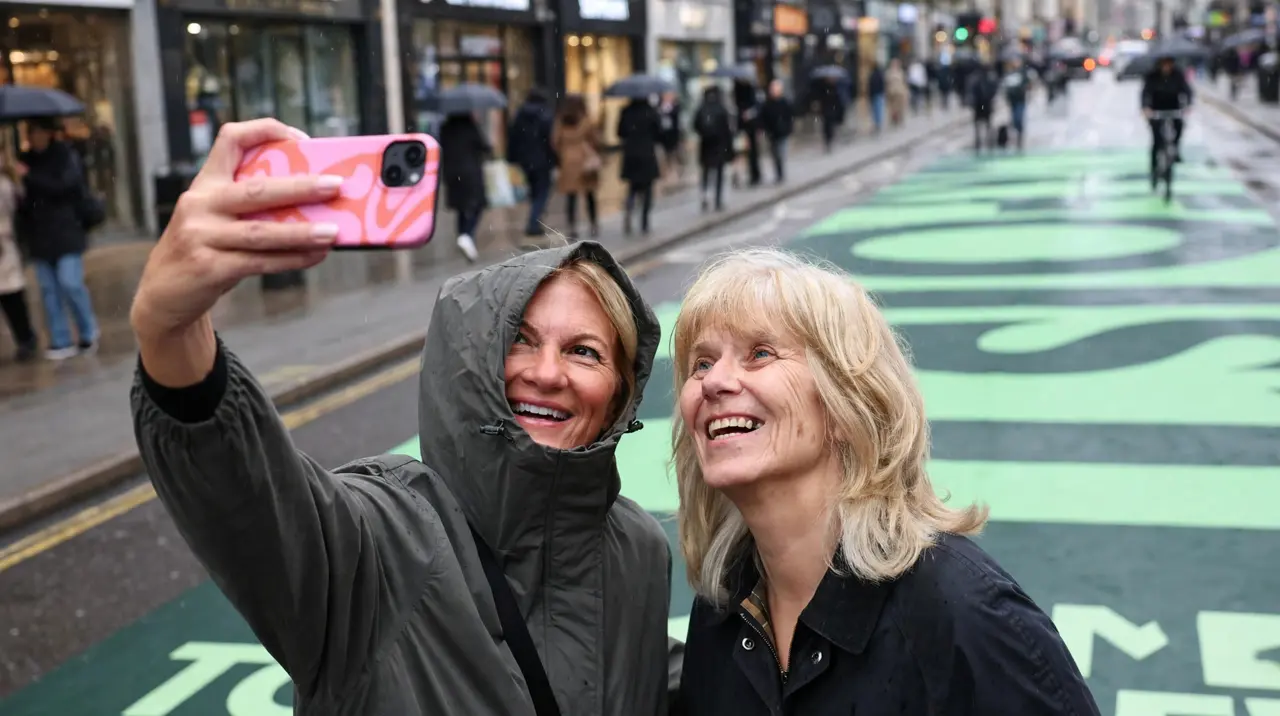
Roughly 1km (0.62 mile) of the thoroughfare, running between Orchard Street and Great Portland Street, has been closed to traffic by the mayor's Oxford Street Development Corporation.
The mayor, Lord Sadiq Khan, described it as a "momentous day for London" and said the scheme represents the opening stage of a programme to reverse the street's "decline".
The rollout drew some confusion, as numerous cyclists continued riding through the freshly placed barriers. Security personnel shouted at several of them to "dismount" and continue on foot. Throughout Monday morning, people were seen travelling through the car-free stretch on bicycles and e-scooters despite the restrictions.
A Transport for London (TfL) spokesperson said riders were "obliged to follow the rules".
"We are working with dockless hire companies and delivery companies to ensure this is made clear and will continue to monitor and review as required," they added.
According to TfL, the authority is cooperating with e-bike hire firms to "enforce strict geo-fencing" across the pedestrianised zone, in addition to deploying barriers and signage. The system would cut or reduce power to dockless e-bikes entering the area, forcing riders to push them. Whether the volume of cyclists disregarding the rules reflects early teething difficulties or a lasting enforcement challenge remains unclear for the weeks and months to come.
One police officer was seen trying to understand the new setup, asking an Oxford Street security worker: "How do I get my car down there?"
As shoppers began arriving in force, many expressed enthusiasm for the transformation. Lucia, who works in the vicinity, made a detour to view the newly pedestrianised street.
"It's very joyful," she said. "We are used to walking on crowded pavements, so it's really exciting to see the people using this space."
"Let's see how it regenerates with time, how different types of businesses pop out, how different spaces for people to hang out appear.
I think in summer it will be lovely. Christmas will be great, it will be more enjoyable."
Other visitors shared her feelings, and as the day progressed, growing numbers of people were seen strolling along the modified roadway rather than remaining on the pavements.
Accessibility was among the issues raised by critics, who questioned whether rerouted bus services, new bus stops and taxi ranks — located roughly 200m and 100m from the pedestrianised zone respectively — would adequately serve disabled shoppers.
A black cab driver told BBC London he feared access to Oxford Street would "become a problem" for some of his disabled passengers.
Adam Gabsi, chair of Inclusion London, said last week that "the proof will be in the pudding".
"If access to buses and taxis becomes difficult, then there'll be problems for people like me," he said, adding that although disabled Londoners were consulted on the plan, it was not co-produced by them.
The sight loss charity Guide Dogs backed the changes, while Wheels for Wellbeing maintained that accessibility must be properly incorporated into the finished design.
Michael Bolt of the Marylebone Association joined other local residents in warning that neighbouring areas could be "ruined" as traffic is redirected onto other roads. Karen Jones, a resident of 20 years, said she was also anxious about the fate of their "beautiful garden neighbourhoods".
Lord Khan said his aim was for people, rather than traffic, to be "in charge" of Oxford Street, and he hoped the street would become a destination for "culture, leisure and tourism".
"This is a street that has been known as the nation's high street for more than 100 years," he said.
"Over the last couple of decades it's been in decline.
I'm not willing to stand by as shops leave this street, as jobs leave this street, and that's why I'm really proud 1km of this street is traffic free."
The mayor indicated the area would be "safe and spacious" in the run-up to Christmas, with further improvement works scheduled for the new year.
"We're going to carry on testing and learning, refining the plans we have to make sure everyone gets to enjoy this street," he said.
"We don't want it to be horrible, we want it to be great.
We are going to learn from this first phase to make sure the next phase takes on people's concerns."
Seb Dance, London's deputy mayor for transport and deputy chair of TfL, said "people will see very quickly the benefits" of pedestrianisation.
TfL had previously told BBC London it anticipated "a manageable increase in traffic" on Wigmore Street, Cavendish Place, Henrietta Street, Marylebone Lane and Welbeck Street.
Tim Barnes, deputy leader of Westminster City Council, noted that residents had repeatedly raised objections whenever pedestrianisation of Oxford Street was proposed in the past.
"We just couldn't find ways that would practically work," he said.
"I think we need to see a lot of how this works in practice. We will be monitoring for traffic problems or noise problems, pollution issues, and taking those back to TfL and the mayor, and charging them with the responsibility of fixing those problems if they've created them."
The Oxford Street Development Corporation, which is overseeing the scheme, said it had worked with the emergency services to understand their access requirements for Oxford Street and would continue doing so as the changes progress. Police, ambulances and the fire service would be able to reach the pedestrianised areas via "multiple access points".
With a projected cost of about £150m, the project involves gradual alterations along the road, including raised road surfaces, new trees and seating, and rephased traffic lights.
The corporation added that "possible future phases are being considered and costed".
Kate Boothman Meier, director of corporate affairs at New West End Company, said: "The ultimate aim is to try and pedestrianise the wider Oxford Street. That is further down the line, we have to see how this goes first."
Additional reporting by James W Kelly, Gem O'Reilly, Lauren Stanley from BBC London and Tom Edwards, BBC London transport correspondent.
Listen to the best of BBC Radio London on Sounds and follow BBC London on Facebook, X and Instagram. Send your story ideas to [email protected]
Source: