Northern line upgrade opens the way for colour blind drivers
Osman Hassan has spent eight years working for TfL, including time in customer service positions, and only recently reached his goal of becoming a Tube train driver.
Chris Slegg Updated 25 nov
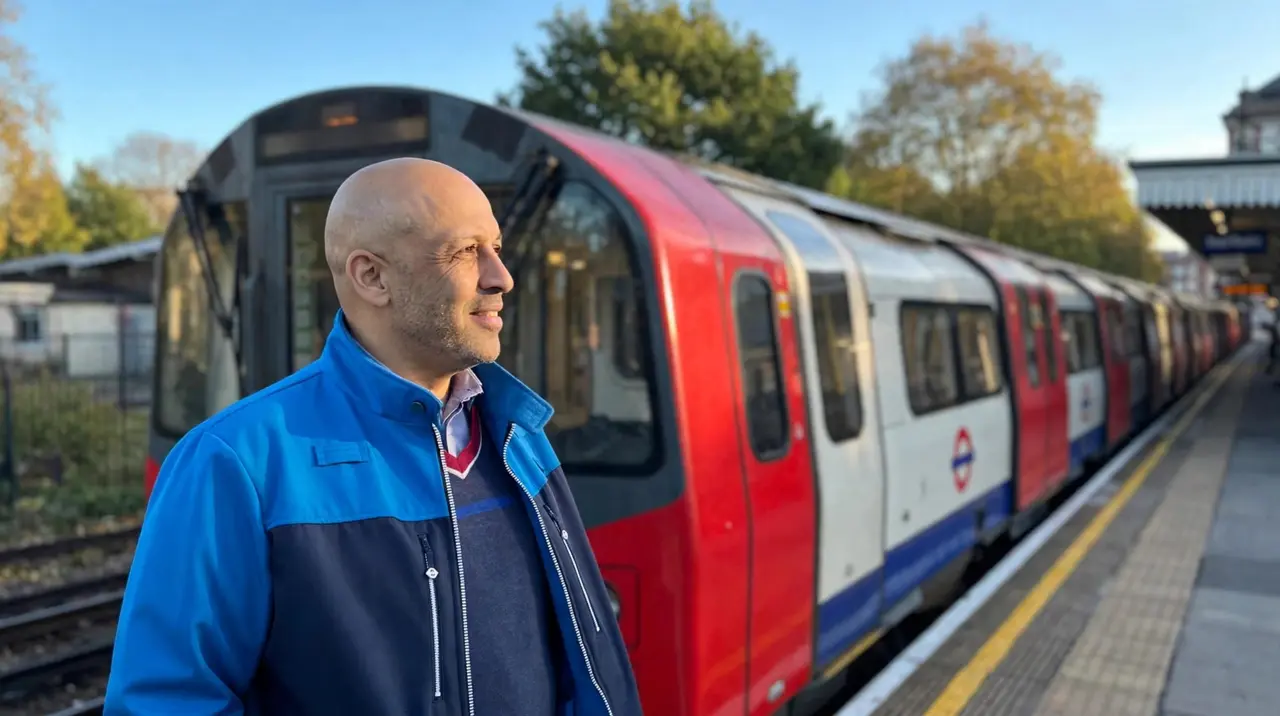
Osman Hassan has spent eight years working for TfL, including time in customer service positions, and only recently reached his goal of becoming a Tube train driver.
Hassan lives with colour vision deficiency (CVD), the condition often referred to as colour blindness.
For much of its history, London Underground signalling relied on red and green lights, which meant that for safety reasons people with CVD could not pursue a driving career across most of the network.
The Northern line, however, is now the second route to be completely modernised in a way that permits drivers with CVD to take the controls.
"It's wonderful," says Hassan.
"I love my job. I love the responsibility of getting people in London safely from A to B and the interaction I have with the public.
"It's brilliant that TfL has been able to make these changes and I hope it prompts other companies to look at what they might be able to do to help employees with CVD."
Roughly three million people across the UK have CVD. The condition is far more prevalent among men, with about one in 12 affected, against one in 200 women.
Although CVD does not automatically count as a disability, for some individuals it represents a substantial impairment, particularly where it limits the jobs they can do or the paths open to them.
In 2018, the Jubilee line became the first – and until now the only – line where drivers with CVD could be employed.
With the Northern line now able to take on drivers with CVD as well, wider opportunities are opening up for staff living with the condition.
Hassan, who previously spent a period driving on the Jubilee line, is one of two CVD drivers currently working on the Northern line.
A central figure in the upgrade is Joe Brown, TfL strategy and change manager.
"It was in 2011 that the Jubilee line replaced red/green signals with automated signals," says Brown.
"A cable running down the centre of the tracks carries a digital signal directly into the driver's cab. A monitor then tells them when it's safe to go.
"I was working on the Jubilee line at the time. One of my drivers approached me and said their younger brother was working on the stations and really wanted to be a driver but couldn't because they had CVD and the rules didn't allow it.
"Since there were no longer red/green signals on the line I decided that we needed to risk assess whether we could accommodate drivers with CVD. It took about a year but in the end we managed to show it was safe."
TfL has now applied the same approach to the Northern line. Digital signalling replaced the red/green signals on most of the route as early as 2014, though important safety concerns persisted.
Trains leaving the main depot at Morden still depended on signals conveyed through red and green flags.
In addition, the safety ladders kept in the driver's cab were colour coded in red and green.
Should a train come to a halt, those ladders might have to be used by the driver so that passengers can be evacuated.
"We've now replaced those red/green flags at Morden with a simple white light and have added a numerical code to the safety ladders," said Brown.
"It's been a team effort, working with the line managers, drivers, the unions and our safety people and I'm really proud of what we've been able to achieve."
Alongside the Northern line, two further routes – the Hammersmith and City line and the Circle line – have also been fully upgraded so that drivers with CVD could potentially work on them.
Looking further ahead, TfL aims to roll out these changes across every line.
Listen to the best of BBC Radio London on Sounds and follow BBC London on Facebook, X and Instagram. Send your story ideas to [email protected]
Source: