Medieval sports and games that still endure in London
Two young London men recently attracted attention with their interpretation of an ancient pastime: jousting.
Bethan Bell Updated 25 nov
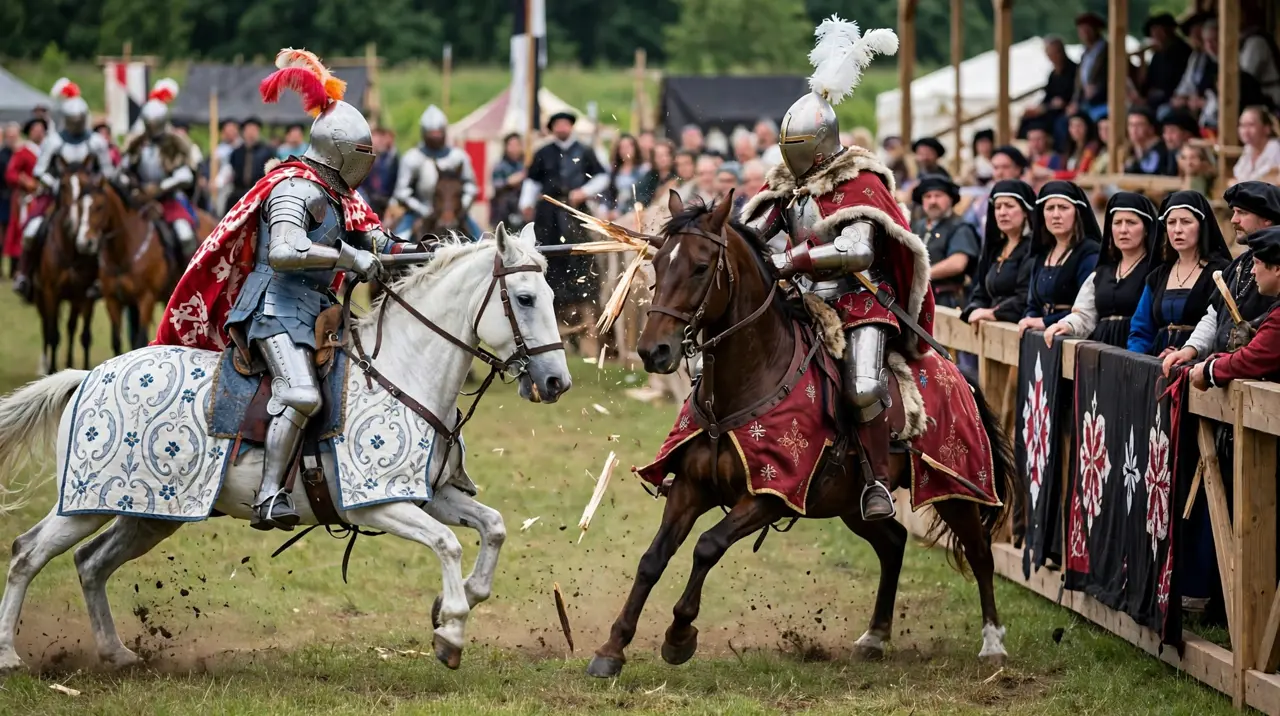
Two young London men recently attracted attention with their interpretation of an ancient pastime: jousting.
On lime bikes and with lances at the ready, actor Cameron Carnegie-Brown and artist Jack Carden gathered in Hackney for a piece of eye-catching medieval dress-up.
Their bicycle-based contest is only one example of people taking up old sports or joining hobbies that trace back to the middle ages. These range from familiar pursuits such as archery to more obscure games like stoolball and hnefatafl (which is indeed spelled that way).
Tennis, skittles and wrestling are still practised sports with mediaeval roots and probably require little explanation, whereas pall-mall and flyting might.
Most medieval sports prepared participants for war. Every man was expected to maintain his bow-and-arrow skills, and knocking a fellow off his horse with a large stick translates readily to the battlefield.
A second area in which mediaeval sports specialised clearly displayed a participant's wealth or status. Hunting, with or without falcons, demanded extensive land and considerable leisure.
William FitzStephen, a cleric, clerk and diarist, became known for writing the biography of his murdered master, Thomas Becket, Archbishop of Canterbury. The prologue to that work contained a vivid portrait of London in the 1170s.
He referred to ice-skating: "When the great marsh that washes the walls of the City on the north side is frozen, crowds of young men go out to amuse themselves on the ice.
"Some fit to their feet the shin-bones of animals, binding them firmly about their ankles, and with an iron-shod pole, which they strike against the ice from time to time, they propel themselves as swiftly as a bird in flight."
FitzStephen also documented horse racing at Smithfield, centuries before Newmarket or the Jockey Club existed: "When a race between such trampling steeds is about to begin, a shout is raised and orders are given that the common horses should be led apart: three jockeys make ready.
"At the signal they stretch out their limbs, gather up their speed, and dash onwards with a zeal that knows no stint."
Today, the racecourse nearest to central London is Kempton Park, roughly 15 miles (24km) to the southwest.
Stoolball, an ancient game, enjoyed an unexpected revival during and after the Great War, when it was modified so that wounded soldiers could play a cricket-like version.
Major Grantham, who arranged a match to raise money for stoolball equipment for all military and naval hospitals, held that the game was "as a form of exercise, stimulating enough without being too violent, for men who have been shattered in body or nerve".
Runs were scored by hitting the ball, bowled underarm, with a frying-pan-shaped bat and running between two targets, originally stools and later a stick topped with a square board.
A Times article from September 1917 reported: "In the presence of a fair gathering of onlookers, an exhibition match took place at Lord's Cricket Ground between a team of officers and men from the Second London General Hospital (damaged by wounds) and a team of Ye Anciente Lawyers (damaged by age).
"The possibilities of the game were scarcely exhausted, as many of those engaged had never played it before. Major W. W. Grantham, with knowledge and experience to help him, scored 30 not out and won the match for Ye Anciente Lawyers by 22 runs."
Full rules and instructions are available, and it was observed that one-armed players could become "very proficient", that one-legged players were entirely able to keep wicket, and that a match was once played in which each team member had one arm while the umpire had no legs.
Flyting is a verbal duel found in medieval Scottish, English and Norse traditions, in which two participants exchange elaborate taunts in verse. Marked by the trading of insults, it has roots in oral traditions throughout Europe.
The practice reaches back to the 5th Century, and those now taking part in poetry slams, storytelling sessions and rap battles can all trace their art to flyting as an earlier form.
Hnefatafl, pronounced NEFF-ah-tah-fell and also called Viking chess, was a widely played strategy game on a board of 9x9 squares. It required 16 dark pieces and eight light pieces, generally round counters, along with one extra king piece, usually taller and often gold.
The two sides had unequal numbers of pieces and different aims. The king began in the centre of the board, encircled by the light pieces, while the dark pieces were arranged in four groups along the board's edge. The defending light side tried to move the king to a corner; the attacking dark side sought to kill him before he reached one.
London hosts numerous board game nights where participants can bring hnefatafl along, and the game is also playable online.
Mob football, little more than a sanctioned riot, played a significant part in the social and cultural life of medieval Europe. Few rules, if any, were observed, and play was defined by very large numbers of participants and chaotic, unstructured action. The objective was to carry a ball, often an inflated pig's bladder, to a designated target that might be miles distant.
The high injury rate and disruptive nature of the game led monarchs and local authorities to ban it on several occasions.
A match was traditionally played on Shrove Tuesday and drew huge crowds in the City of London and in towns such as Kingston upon Thames, with many Londoners simply calling the day Football Day.
London enthusiasts can get a similar experience by gathering in Oxford Circus in the run-up to Christmas, or by travelling to Ashbourne in Derbyshire for the annual Royal Shrovetide Football match.
Quarterstaff combat, essentially stick-fighting, is described as "perhaps the most versatile of weapons", though more convenient options for travelling around the city are easy to imagine.
The staff is handled in two principal ways: Shortform and longform. Shortform relies on opposing push-and-pull movements of the hands for attacks and defences that are compact and relatively easy to control. Longform employs changes of grip and sliding movements to increase the weapon's reach.
Modern quarterstaff duelling tends towards the theatrical rather than the violent. The Fleur De Lis theatre company, for instance, runs stage combat workshops covering how to wield a 6 ft (1.83m) wooden staff in a threatening yet safe manner.
For those drawn to sword-fighting, the London Historical Fencing Club, based in central London, offers classes in Longsword, Rapier, Sabre and Smallsword.
Pall-mall completes the list. Its name comes from the Italian words palla (ball) and maglio (mallet), reflecting how the game was played: a boxwood ball was struck with a heavy mallet through a tall iron arch or hoop.
Areas set aside for pall-mall were called pall-mall alleys, typically long, straight courses with well-maintained surfaces. One of the most famous lay in St. James's Park in London and lent its name to the well-known street.
Londoners today can play croquet instead, though they should stay off busy thoroughfares and visit one of the capital's many clubs, as listed by Croquet England.
Listen to the best of BBC Radio London on Sounds and follow BBC London on Facebook, X and Instagram. Send your story ideas to [email protected]
Source: