From a £250 job to a £9,000 bill: How rogue trader networks scam customers on a large scale
Organised groups of rogue plumbers and electricians have been targeting customers on a large scale, according to a BBC investigation.
Jessica Ure, Zack Adesina and Laurence Cawley (London and East Investigations)
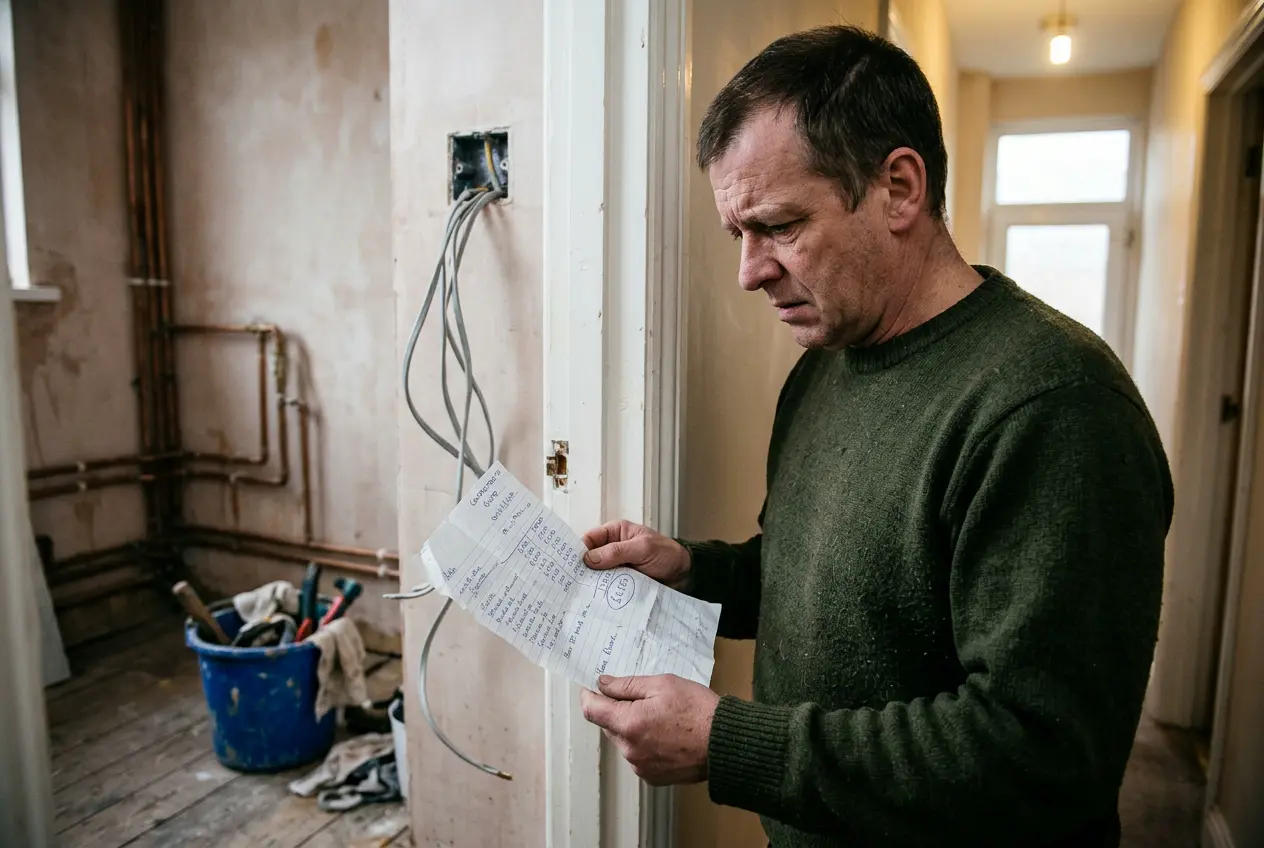
Organised groups of rogue plumbers and electricians have been targeting customers on a large scale, according to a BBC investigation.
Nessar Khawaja, who published under the online alias ThatGuyNess, frequently shared TikTok videos about his plumbing work, describing how he earned thousands of pounds from "desperate" customers while recruiting online to grow his network.
"Me and my team, we're top of the food chain," he said in one video.
The investigation identified the 23-year-old as a central figure in an organised group that systematically defrauds customers and teaches others to do the same.
The BBC put these allegations to Khawaja in writing. He rejected any wrongdoing and said his social media posts were meant as light-hearted comedy rather than a reflection of how he actually operated.
During a recorded phone call, Khawaja maintained that he was an entertainer, that he was joking and that the BBC had "taken things out of context".
In a separate video, Khawaja claimed he had electricians working for him who earned more than £40,000 a month.
"I've got 100-120 engineers. Imagine how much money I am making them and making from them," he said.
One of Khawaja's associates told an undercover BBC journalist, during a secretly recorded recruitment call, that engineers working for them had to surrender 60% of every job's payment to the network.
When asked for comment, TikTok said it had banned the account for "breaching its rules on fraud and scams".
Trading Standards said the average call-out scam by a rogue trader now costs the victim about £10,000.
The consequences can be devastating.
Clive, who lives in London, is receiving cancer treatment.
He said he felt compelled to pay a rogue trader who visited his home and billed him £9,153 for fitting an outdoor socket for garden lights he already owned.
An independent electrical expert told the BBC that the work was carried out badly, left the installation in an unsafe condition and should have cost no more than £250.
Clive said he no longer feels safe in his own home.
He explained that he searched for a local electrician on Google when his usual tradesperson was unavailable and found Chriss Electrician Ltd.
According to Clive, the engineer was at the property for roughly two hours before presenting the bill.
"I was shocked," said Clive.
He added that he felt pressured into paying because the work had already been finished.
Clive went to his local bank branch to move money between accounts, then returned home and paid through the engineer's portable card reader.
Even so, despite his concerns about the cost, Clive said he feared what could happen if he refused to pay.
"If I hadn't paid him, I thought something might happen," he said.
"When people come to the door now, I think, 'Oh God, who's that?' I don't feel safe any more."
Dissolved companies
Although the BBC has found no evidence that Khawaja controls or runs Chriss Electrician Ltd, it established the following:
Companies House lists Chriss Electrician Ltd at an address in Ilford.
Khawaja appears as the registered director of two dissolved companies located in that same building, one of them in the very same flat.
Khawaja's firm, First Choice Maintenance 24/7 Limited, was registered 22 days before Chriss Electrician Ltd was incorporated, using the same flat as its address.
The BBC approached Chriss Electrician Ltd for comment but received no response.
Khawaja denied any link with Chriss Electrician Ltd.
Clive was reimbursed by his bank after the BBC contacted it. The bank said it did so as a "gesture of goodwill".
Like Clive, another man whom the BBC has identified as Tom felt he had no option but to settle the bill after mistakenly summoning a rogue trader to his home in Essex following the discovery of a leak.
He says he was first quoted £49 on the phone after dialling a listing at the top of Google that purported to belong to an established business.
However, once on site, the plumber raised the call-out fee to £250 and the charges continued to mount.
"He charged us for the first load of repairs, and then the second load with the water cylinder. Basically, he was running my taps constantly saying, 'Look, it's coming out this hot', which caused me to panic."
The plumber ultimately presented a bill of £6,237.60.
"I noticed afterwards that the invoice said Ibby & Co. Ltd. That was when alarm bells started ringing because I had never heard of that company. It wasn't the company I called out, essentially."
Customer received threats
Tom summoned a second plumber for an opinion and was told the completed work should have cost no more than £1,000.
When Tom contacted the company to complain, an unidentified man threatened him. The BBC recorded the call and heard threats including: "We'll show up at your house. And we're gonna be sleeping there for months."
Ibrahim Nazir, the plumber who attended Tom's property and the registered director of Ibby and Co Ltd, was approached by the BBC for comment but did not respond.
Sources close to Khawaja place Nazir within the same network.
Khawaja said he knew nothing about the job involving Tom and stated that Nazir was not employed by him.
Insiders say that exploiting vulnerability and desperation is central to the rogue trader business model.
One insider supplied the BBC with a script circulated by a separate rogue trader network that recruits young men for commission-based work.
The document instructs recruits to raise prices when children or pets are trapped inside, and even tells them to pretend to pick a lock for seven minutes before drilling it.
'You make up the pricing'
Lee, which is not his real name, worked as a plumber for Khawaja for a year until, in his own account, his conscience forced him to quit.
"It got a bit too much for me," he said. "I didn't like scamming people. So, I left.
"I've worked for London's biggest plumbing company and, no word of a lie, this lot have more jobs. They're giants."
Instead of building a solid reputation and relying on recommendations, rogue traders depend on search engine traffic.
They either pay to have their details placed at the top of Google, so they appear first, or they imitate the names of reputable companies with minor alterations to the business name.
When the BBC's undercover journalist, posing as a plumber seeking work with them, reached one of Khawaja's associates, the associate said: "We're a lead company. We'll send you jobs, and then you go to the jobs.
"We sort the jobs through online advertisement. Usually we'll try and get emergencies so we can charge more. You make up the pricing."
The associate told the undercover reporter they had to bill in the region of £400 for every job, no matter what work was actually required.
Both Clive and Tom reported what happened to the Metropolitan Police and Essex Police.
Khawaja said he was not part of the phone call with the undercover journalist and could not discuss its contents.
He said the alleged statements did not reflect how he operates.
In the recorded phone call, he separately told the BBC: "You guys should know I am an entertainer and you guys are taking it out of context."
"I am clearly joking and I'm entertaining and I am engaging with the comments, it is not literal," he added.
He said the right of reply sent to him by the BBC contained "false information which has nothing to do with me".
What did TikTok and Google say?
TikTok said its community guidelines were "clear" and did not "allow any attempts to scam, trick or defraud people".
The company said that in the three months up to June 2026 it had removed 99.2% of content identified as breaching its "policies on fraud and scams... before it was reported to us".
The BBC raised questions with Google, including why rogue traders were able to advertise on the platform. Google did not reply to the specific questions, but a spokesperson said: "We have strict ads policies that govern the types of ads and advertisers we allow on our platforms.
"Keeping our users and partners safe is our top priority and we invest heavily in the enforcement of our policies.
"We have a team of thousands working around the clock to create and enforce our policies at scale."
Source: