Croydon tram crash families say justice remains undone a decade on
Tram 2551 derailed on a sharp curve at 06:07 GMT on 9 November 2016, travelling at more than 43mph (70km/h) — over three times the recommended limit. Sixty-nine passengers were aboard; seven died and 61 were injured.
Tom Edwards (London transport and environment correspondent) Updated 25 nov
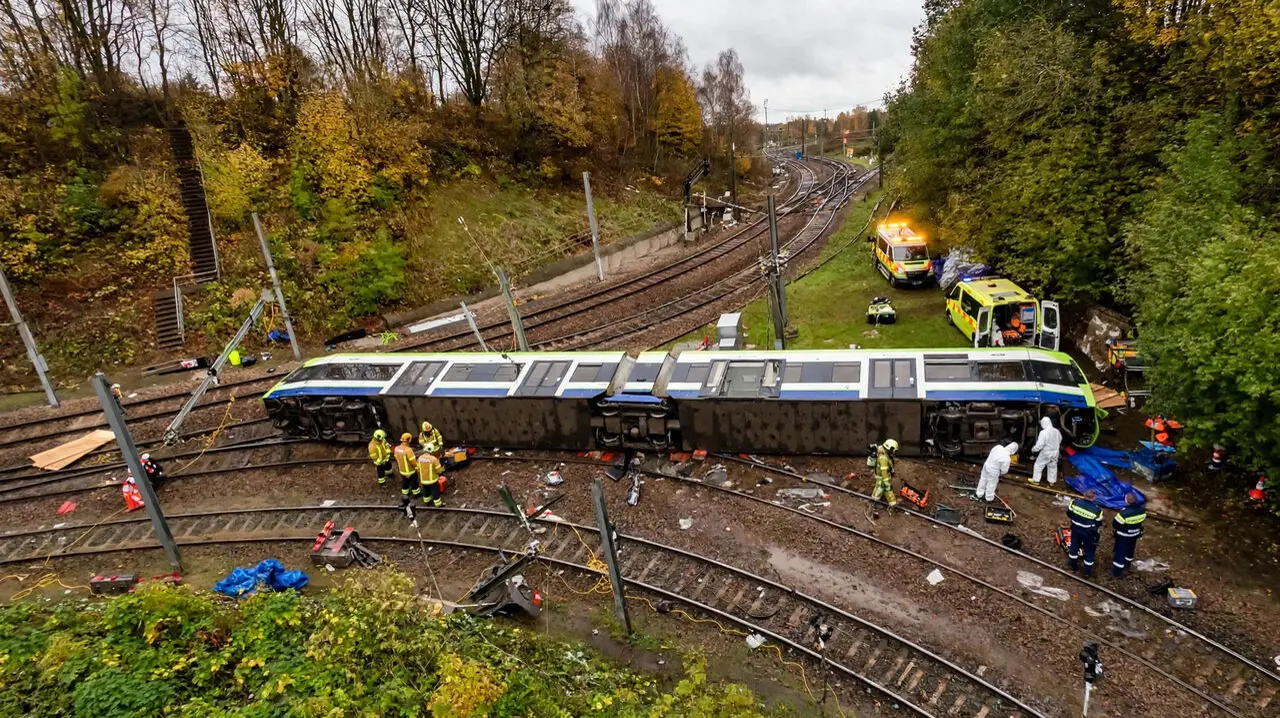
Tram 2551 derailed on a sharp curve at 06:07 GMT on 9 November 2016, travelling at more than 43mph (70km/h) — over three times the recommended limit. Sixty-nine passengers were aboard; seven died and 61 were injured.
Driver Alfred Dorris was cleared of health and safety offences at trial. Transport for London (TfL) and Tram Operations Limited (TOL), however, were fined a combined £14m for breaching their health and safety duties.
"It's a milestone at 10 years, but to us we live with it everyday. Justice was not served," says Jean Smith, whose son Mark died in the derailment.
Danielle Richardson, whose grandfather Phillip Logan was killed, said: "I'm always going to feel bitter. I'm always going to feel that anger towards Transport for London."
Those who died were Dane Chinnery, 19, Philip Seary, 57, Dorota Rynkiewicz, 35, Robert Huxley, 63, and Philip Logan, 52, all from New Addington, plus Donald Collett, 62, and Mark Smith, 35, both from Croydon. Among the 61 injured, 19 were seriously hurt, suffering conditions ranging from chronic pain to amputations. All of them were travelling to work.
Richardson said the past decade has taken its toll on her and her family.
"This anniversary is going to be particularly difficult. But I can still hear his voice in my head and I hope I do for many years," she says.
"The sadness is very much there, I have really struggled in the last three years. The trauma is still having repercussions for me and my family. Once the trial was over everything just stopped. Grief really took over then.
"We have been through so much trauma."
She also feels "really let down" by TfL over the support and counselling provided.
"From when this began, I've not had any contact from TfL," she says.
"I've received nothing from TfL in the 10 years. I feel that I should have had that offer of counselling at the beginning, given that I'd been at the forefront for my family."
Richardson is likewise unhappy that a loophole remains open, meaning safety laws cover trams on roads but not on tramways. As a result, standard motoring charges could not legally be applied to the driver.
"Justice is never ever going to be done. We are just left to live our lives," she says.
"I'm always going to be bitter, I'm always going to feel anger towards TfL, I'm always going to feel that anger towards the driver, because ultimately someone was to blame that morning.
"And here we are 10 years on remembering our loved ones and our loved ones should be here, enjoying family time and making memories. "
She believes such an accident could recur.
"It will happen again 100%. It might not happen again in Croydon, but it will happen somewhere again in the UK," she says.
"Unless there's a change in that law, the driver is not going to be held accountable."
Smith agreed, saying "justice was not served".
"Everyday is a reminder that Mark is not here," she adds.
"He's still deeply loved and missed by all his friends and family and that situation goes for the other six victims and their families too."
Dorris faced charges under the Health and Safety at Work Act 1974 over the derailment but was found not guilty of failing to take reasonable care of his passengers. The jury at the Old Bailey acquitted him in under two hours.
During the trial, Dorris repeatedly stated that he had not dozed off while driving the tram, saying instead that he felt confused and disorientated. He told the jury he believed he was travelling in the opposite direction on a section without a curve.
The court also heard that TfL and TOL had permitted a safety blind spot to emerge. No risk assessment was ever carried out for a possible high-speed derailment on the sharp corner into Sandilands, where the crash occurred. The court was told that measures to control the risk of derailment were absent, and prosecutors said the operator had created "an accident waiting to happen".
There were no signs in the tunnel, which the Rail Accident Investigation Branch (RAIB) deemed "inadequate", and the tram had no automatic speed restrictors. The jury concluded that system errors, rather than the driver, were at fault.
A similar incident had occurred just 10 days before the crash at the same corner. An RAIB investigation found that the tram was travelling too fast and nearly overturned; the driver applied the hazard brake but did not report it, while a passenger did. The complaint was not followed up promptly, and by the time the company had established the facts, the CCTV footage had auto-deleted. The complaints procedures have since been taken back under TfL.
The RAIB survey of drivers also identified nine who admitted using the hazard brake at the same Sandilands corner. None reported it, and management was unaware of these incidents.
'Wake-up call'
TfL and TOL both pleaded guilty to failing to take reasonable care under health and safety laws. TfL was fined £10m and TOL £4m.
The tram network has seen changes since the crash: improved signage, additional speed restrictions, an automated braking system and speed monitoring, and updated CCTV.
A Department for Transport spokesperson said: "The safety of passengers is our priority, which is why the tram industry, operators and regulators have delivered safety improvements following the Rail Accident Investigation Branch's recommendations.
"We have provided more than £7m since 2019 to co-fund the Light Rail Safety and Standards Board alongside the sector, helping improve safety and manage risk across Britain's light rail networks."
Finn Brennan, the Aslef union's full-time organiser on London Underground and Croydon Tramlink, said: "It was a wake-up call for the industry. Both Tram Operations Ltd, a FirstGroup company, who operate the tram system, and Transport for London, who controlled the infrastructure, pleaded guilty to offences under the Health and Safety at Work Act and were fined heavily.
"As a result of the accident, major safety improvements have been made to the tram network, including an automated braking mechanism in high-risk areas.
"We should never have to wait until after a tragic accident for measures to make sure that passengers and staff on public transport are kept safe. But, far too often, that is exactly what happens. Saving lives, not saving money, should always be the priority for every employer."
Mark Davis, TfL's general manager for London Trams, said: "As we mark 10 years since the Sandilands tram tragedy, we remember the seven people who so tragically lost their lives and pay tribute to their memory.
"Our thoughts are also with their families, friends and loved ones, and with all those whose lives were forever changed by this devastating event.
"We remain committed to supporting those affected and to doing everything possible to ensure a tragedy like this can never happen again."
TfL said it was "very sorry" to anyone who feels let down by the support on offer from the transport body. It said it had previously contacted the families of those who died and everyone injured to offer support and counselling, and that anyone needing further help could get in touch through the Sarah Hope Line.
The tragedy is widely regarded as having been forgotten. On the day of the anniversary, news coverage of Donald Trump's arrival at the White House overshadowed it. The families have previously made unsuccessful appeals for a public inquiry.
Ten years on, questions remain about how a lax safety regime was allowed to take hold and how systemic failings contributed to the deaths of seven commuters.
Listen to the best of BBC Radio London on Sounds and follow BBC London on Facebook, X and Instagram. Send your story ideas to [email protected]
Source: